
1939.NZL.01Boy Scouts' Jamboree Christmas
 New Zealand·1939
Publicity seals for the New Zealand Centennial Boy Scouts' Jamboree, planned for Christmas 1939 / January 1940 at Heretaunga and cancelled after the outbreak of war
Series details
Identity
- CodeSeries code YYYY.ENT.SS — year, 3-letter issuing entity, sequence (e.g. 1900.CGH.01).
1939.NZL.01- EntityPostal authority that issued the stamps (country, territory, or historical entity).
- New Zealand (NZL)
- Year
- 1939
- Event
- Publicity seals for the New Zealand Centennial Boy Scouts' Jamboree, planned for Christmas 1939 / January 1940 at Heretaunga and cancelled after the outbreak of war
- TypeIssue kind. Charity issue = postage + voluntary surcharge (e.g. 6+4), not an overprint.
- Cinderella
Production
- Printer
- Coulls Somerville Wilkie Ltd
History
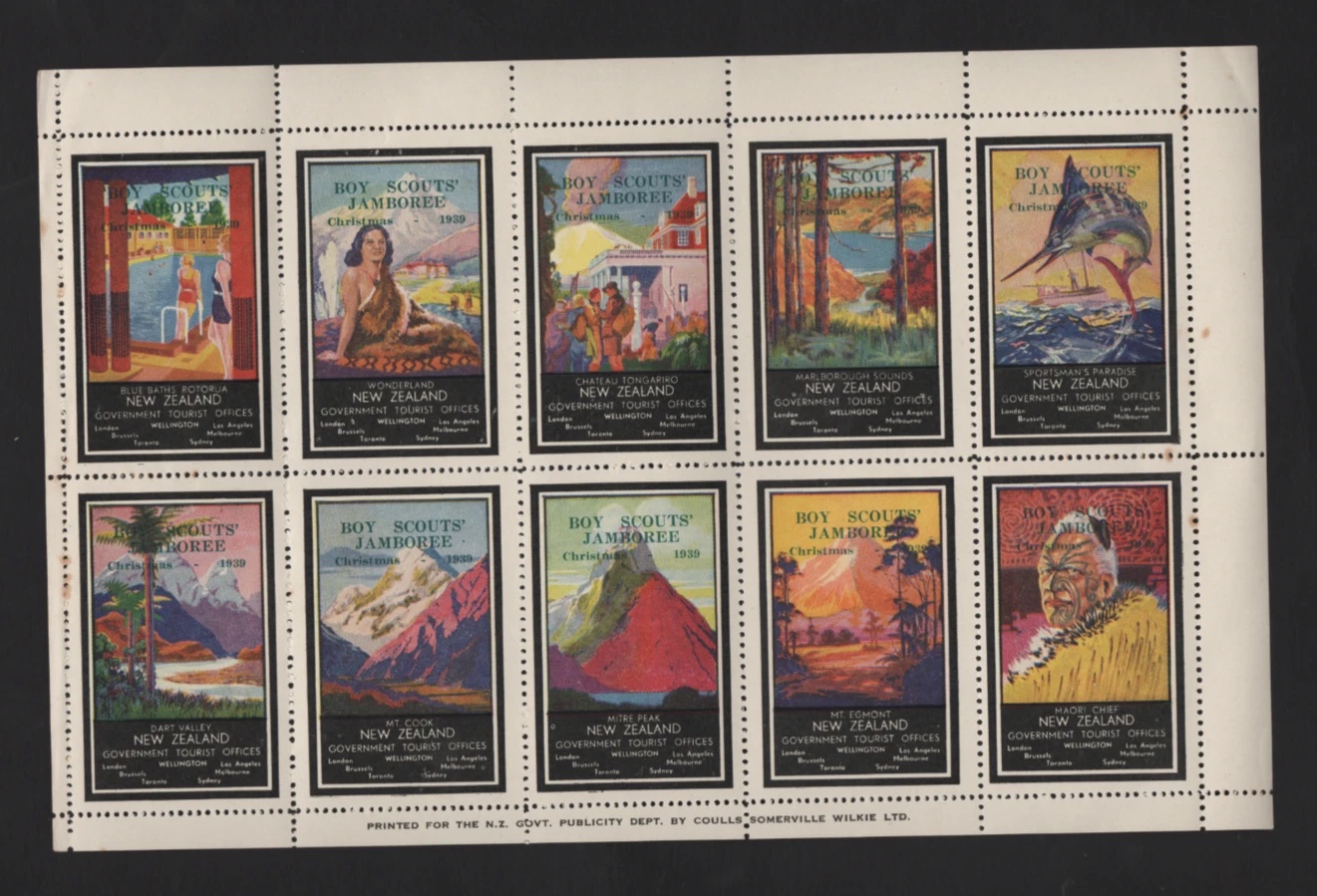
Ten multicoloured publicity labels printed for New Zealand's Government Tourist Offices and inscribed across every design BOY SCOUTS' JAMBOREE Christmas 1939. They carry no face value and had no postal validity: cinderella seals advertising the New Zealand Centennial Boy Scouts' Jamboree that was planned for December 1939 and January 1940 at Heretaunga, near Wellington.
The sheet is two rows of five perforated labels. Each stamp shows a New Zealand tourist subject above a dark panel lettered with the place name, NEW ZEALAND, GOVERNMENT TOURIST OFFICES, and a line of overseas office cities ending with WELLINGTON. Reading left to right and top to bottom the designs are: Blue Baths, Rotorua; Wonderland (a woman in Māori dress beside a geothermal pool); Chateau Tongariro; Marlborough Sounds; Sportsman's Paradise (a marlin rising beside a fishing launch); Dart Valley; Mt. Cook; Mitre Peak; Mt. Egmont (Taranaki); and a Māori chief in feather cloak and facial moko. The bottom margin of the sheet reads PRINTED FOR THE N.Z. GOVT. PUBLICITY DEPT. BY COULLS SOMERVILLE WILKIE LTD.
The jamboree itself was cancelled after the outbreak of the Second World War. Organisers announced in September 1939 that the gathering would not take place: the Heretaunga camp site was no longer available, technical help and supplies could not be secured, and staff who had been preparing the camp were needed elsewhere. The seals remain as publicity for an event that never opened.