
Carl Lønberg, Gothersgade 115 — Spejder-Artikler
Piece details
Identity
- Piece codeStamp code YYYY.ENT.SS-PP — series code plus stamp order (e.g. 1900.CGH.01-02).
1913.DNK.01-01- SeriesThe set this stamp belongs to.
- Carl Lønberg — Spejder-Artikler
1913.DNK.01· piece 1 of 1 - EntityPostal authority that issued the stamps (country, territory, or historical entity).
 Denmark (DNK)
- Year / date
- 1913
- Face valueDenomination on the stamp; +n is a charity surcharge when present.
- No face value
- Format
- Stamp
- TypeIssue kind. Charity issue = postage + voluntary surcharge (e.g. 6+4), not an overprint.
- Cinderella
- Colors
- Multicoloured
- CollectionIn collection if you have it; Purchased if it is bought but not yet received (do not buy again); Wanted otherwise.
- ✓ In collection
Notes
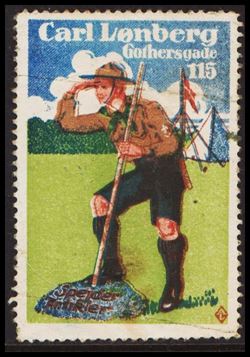
Advertising label for Carl Lønberg scout equipment, Gothersgade 115, Copenhagen. Boy scout saluting with staff; tent and flag in the background. Legend «Spejder-Artikler».
Series history
Danish Scouting was still very young in 1913: Det Danske Spejderkorps had been founded only a few years earlier (1909), and commercial support for the movement was already appearing in Copenhagen.
This multicoloured perforated label is not a postage stamp. It is a reklammærke / plakatmærke (advertising poster stamp) issued for Carl Lønberg, a supplier of Spejder-Artikler (scout articles / equipment) at Gothersgade 115 — the address of the K.F.U.M. (YMCA) building in central Copenhagen. Scout supply shops and depots later used the same address; the shop name Carl Lønberg still appears in mid-century Danish scout-equipment records linked to that street.
The design shows a boy scout in brown uniform and campaign hat giving the scout salute, staff in hand, with a pitched tent and a flag behind him on a green field — pure outdoor-scout imagery used to sell kit. The shop name and street address sit in the blue sky; “Spejder-Artikler” is lettered on a rock at the scout’s feet.
Catalogued as a 1913 Denmark cinderella with scout motive, the stamp is an early commercial witness to Danish Scouting: it shows how, within a few years of the movement’s arrival, private shops were already marketing uniforms and gear with the visual language of camp and readiness.