
Scouten sveriges basta ungdomstidning
Piece details
Identity
- Piece codeStamp code YYYY.ENT.SS-PP — series code plus stamp order (e.g. 1900.CGH.01-02).
1915.SWE.01-01- SeriesThe set this stamp belongs to.
- Scouten — Sveriges bästa ungdomstidning
1915.SWE.01· piece 1 of 1 - EntityPostal authority that issued the stamps (country, territory, or historical entity).
 Sweden (SWE)
- Year / date
- 1915
- Face valueDenomination on the stamp; +n is a charity surcharge when present.
- No face value
- Format
- Stamp
- TypeIssue kind. Charity issue = postage + voluntary surcharge (e.g. 6+4), not an overprint.
- Cinderella
- Colors
- Multicoloured
- CollectionIn collection if you have it; Purchased if it is bought but not yet received (do not buy again); Wanted otherwise.
- ✓ In collection
Series history
Scouting reached Sweden in the years around 1909–1910. Gymnastics teacher Ebbe Lieberath translated Baden-Powell’s Scouting for Boys and founded the Riddarpojkarna troop in Gothenburg (1910); Sveriges Scoutförbund was organised nationally in 1912. Within a few years the movement already needed its own press — magazines that taught outdoor skills, published news from troops, and sold the scout idea to Swedish youth.
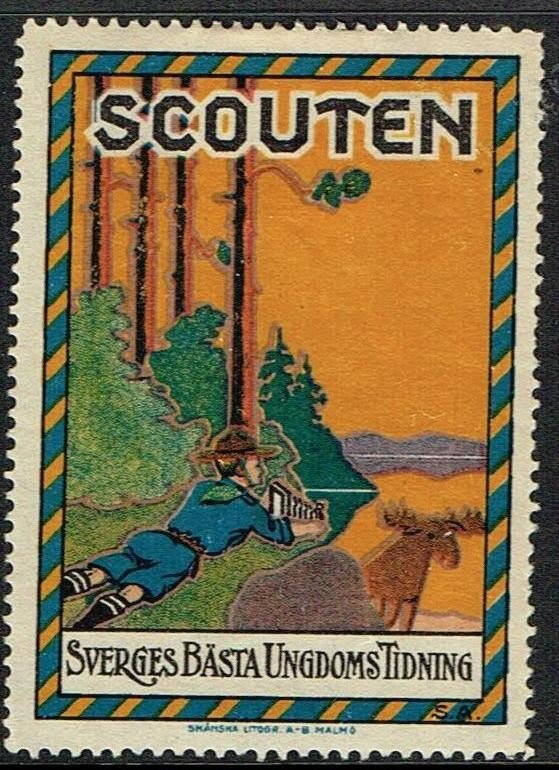
This label is not a postage stamp. It is a reklammärke (poster / advertising stamp) promoting Scouten, a Swedish youth magazine that marketed itself with the slogan “Sveriges bästa ungdomstidning” (“Sweden’s best youth magazine”). The design is conventionally dated to 1915, in the first half-decade of organised Swedish scouting. Such labels were stuck on letters, packages and shop windows to advertise publications and causes; they had no franking value.
The design shows a scout in blue uniform and campaign hat lying on a hillside, watching a moose (älg) across a lake among pine trees — a romantic outdoor scene that ties the magazine to Swedish nature as well as to scouting. The frame is blue and yellow (national colours). At the foot of the design the printer is named: Smånska Litograf. A.-B., Malmö (a Scanian lithographic firm), with the artist monogram “F.R.”
The label therefore documents two things at once: the commercial side of early Swedish scout publishing, and the visual language scouts used to sell the movement — fieldcraft, wilderness and the scout’s watchful eye — long before modern membership magazines replaced these early titles.