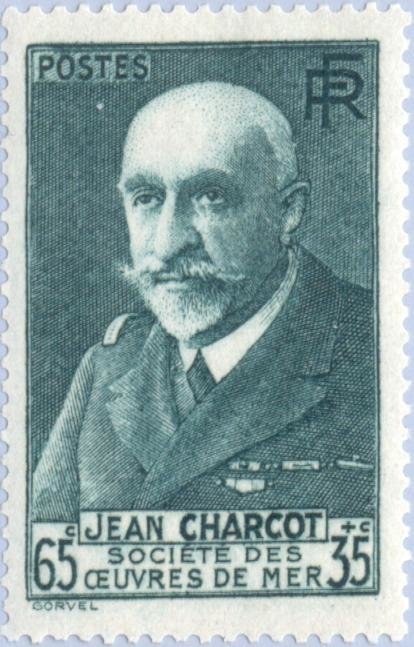
Jean-Baptiste Charcot — 65 + 35 c
Piece details
Identity
- Piece codeStamp code YYYY.ENT.SS-PP — series code plus stamp order (e.g. 1900.CGH.01-02).
1938.FRA.01-01- SeriesThe set this stamp belongs to.
- Jean-Baptiste Charcot — Society of Sea Works
1938.FRA.01· piece 1 of 1 - EntityPostal authority that issued the stamps (country, territory, or historical entity).
 France (FRA)
- Year / date
- 1938-03-25
- Face valueDenomination on the stamp; +n is a charity surcharge when present.
- 65 + 35 c
- Format
- Stamp
- TypeIssue kind. Charity issue = postage + voluntary surcharge (e.g. 6+4), not an overprint.
- Charity issue
- Colors
- Dark blue-green
- CollectionIn collection if you have it; Purchased if it is bought but not yet received (do not buy again); Wanted otherwise.
- ✓ In collection
Production
- PerforationsHole gauge between stamps (e.g. 12, 13½). Higher ≈ finer.
- Comb13
- Printing
- Recess
- Size
- 26 x 40 mm
Catalog numbers
- DomfilDomfil thematic catalog number (scouting).
- 938.34
- ScottScott catalog number (Americas).
- FR B68
- MichelMichel catalog number (Europe / DE).
- FR 406
- YvertYvert & Tellier catalog number (FR).
- FR 377
- Stanley GibbonsStanley Gibbons catalog number (UK / Commonwealth).
- FR 593
Notes
Portrait of Jean-Baptiste Charcot (1867–1936). Semi-postal for French seamen. Printed in sheets of 25. Domfil 938.34.
Series history
On 25 March 1938 France issued a semi-postal portrait of Jean-Baptiste Charcot (1867–1936), the polar explorer and naval doctor who commanded the Pourquoi-Pas? and became a national figure of French maritime exploration. Face value is 65 centimes postage plus 35 centimes surtax for the benefit of French seamen (Society of Sea Works / Œuvres de mer). The stamp was designed by Gorvel, engraved by J. Piel, printed by recess (intaglio), comb perforation 13, in sheets of 25, size about 26 × 40 mm. Print run is reported at about two million.
Scout catalogues (Domfil 938.34; Scouts-on-Stamps literature) place Charcot among the founders or early organisers of French Scouting — especially the sea-oriented branch — though specialist notes record that the strength of that claim is debated. What is clear is that the design is a statesman-explorer portrait for a seamen’s charity, not a Scout in uniform; the thematic interest is biographical and organisational rather than pictorial camping or jamboree scenes.
A second Charcot value (90 + 35 c, Scott B69) appears in some catalogues for a related 1938–39 seamen’s issue; only the 65 + 35 c (B68) is the official piece of this series. Multiples such as a block of four are optional display material, not separate catalog numbers.