
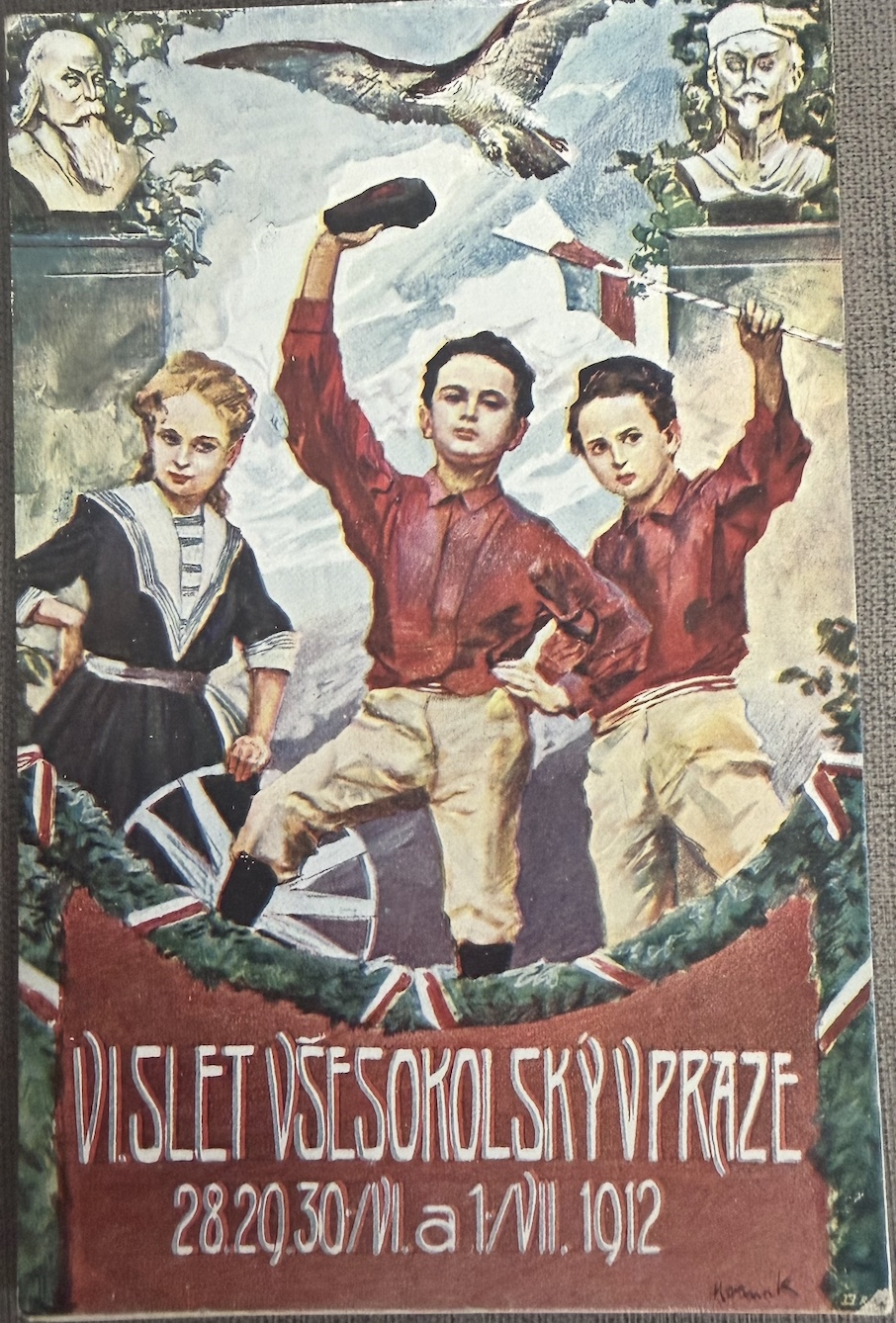
VI. Slet Všesokolský, Prague 1912 — picture postcard
Piece details
Identity
- Piece codeStamp code YYYY.ENT.SS-PP — series code plus stamp order (e.g. 1900.CGH.01-02).
1912.CSK.01-01- SeriesThe set this stamp belongs to.
- Sokol — the movement that brought Scouting to the Slavic lands
1912.CSK.01· piece 1 of 3 - EntityPostal authority that issued the stamps (country, territory, or historical entity).
 Czechoslovakia (CSK)
- Year / date
- 1912-06-28
- Format
- Postcard
- TypeIssue kind. Charity issue = postage + voluntary surcharge (e.g. 6+4), not an overprint.
- Picture postcard
- CollectionIn collection if you have it; Purchased if it is bought but not yet received (do not buy again); Wanted otherwise.
- ✓ In collection
Notes
Colour postcard for the sixth All-Sokol Slet, 28–30 June and 1 July 1912. Three young Sokols in red shirts on a garlanded rostrum, one raising his cap, a falcon overhead and the busts of the founders Tyrš and Fügner on plinths to either side. Caption VI. SLET VŠESOKOLSKÝ V PRAZE, 28.29.30/VI. a 1/VII. 1912.
Series history
Sokol means falcon in the Slavic languages. The movement was founded in Prague in 1862 by Miroslav Tyrš and Jindřich Fügner as a gymnastic society, and grew into something much larger: a network of clubs that carried Czech, Polish, Slovene, Croatian and Serbian national feeling through the last decades of Austria-Hungary, under the cover of physical culture. Its great ritual was the slet — literally the flocking of birds — a mass gymnastic rally held in Prague every six years.
The Sokol belongs in a Scout catalogue because it is where Scouting entered the Slavic lands. From 1910 the Sokol clubs of Galicia and Bohemia began introducing and organising the Scout system within their own structures, and in Poland the movement was not merely influenced by the Sokół but born inside it: on 28 February 1911 the board of Towarzystwo Gimnastyczne «Sokół-Macierz» in Lwów resolved to establish Polish scouting, and on 22 May 1911 Andrzej Małkowski, an instructor of the society, issued the order creating the first four troops — the third of them a girls' troop named for Emilia Plater. Małkowski had translated Scouting for Boys at the society's prompting and launched the magazine Skaut in Lwów. In Bohemia the line runs through A. B. Svojsík, a Sokol gymnast who founded Junák in 1912. The Czech and Polish words for Scout, junák and harcerz, both come from this milieu rather than from any translation of the English.
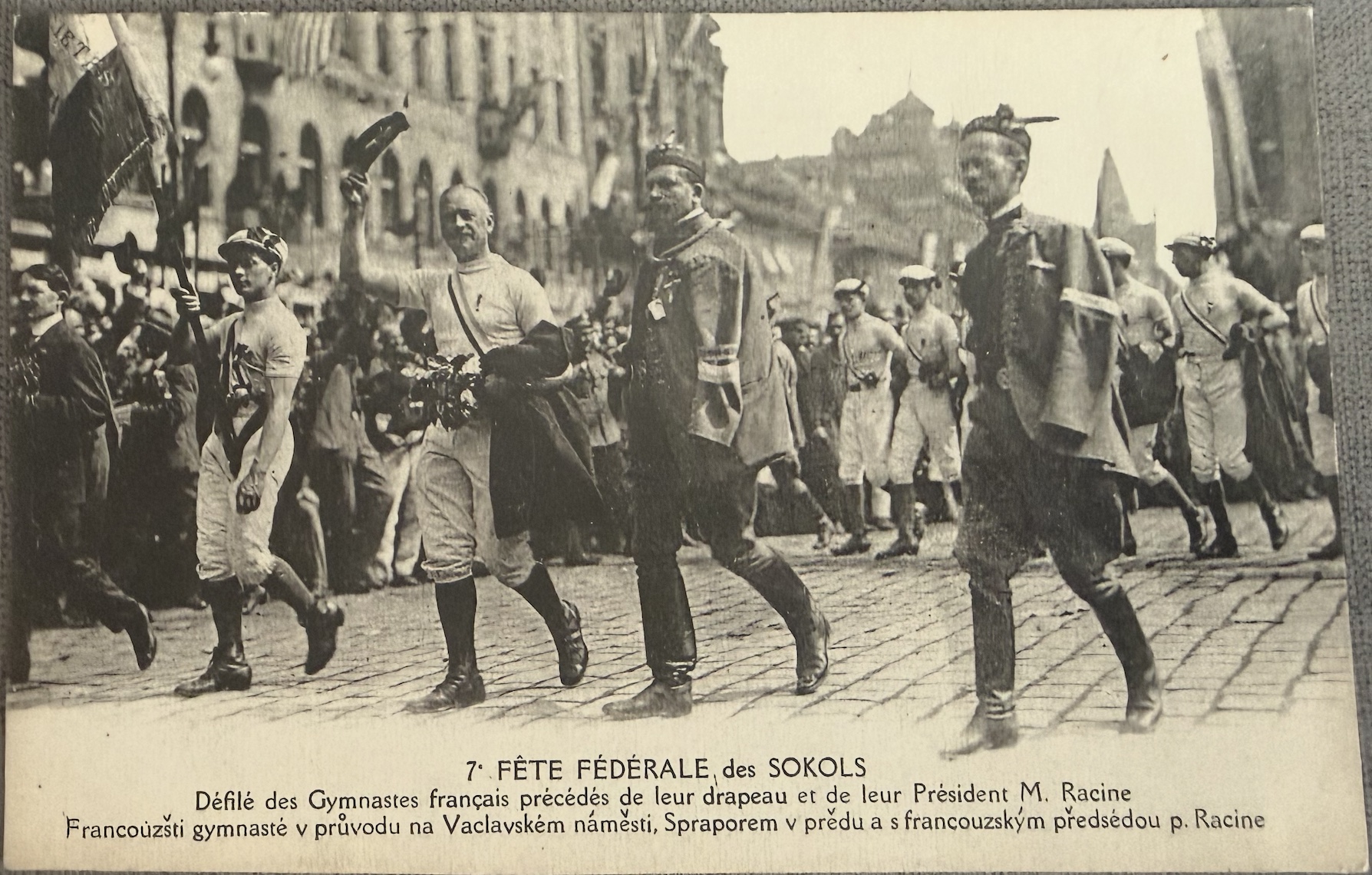
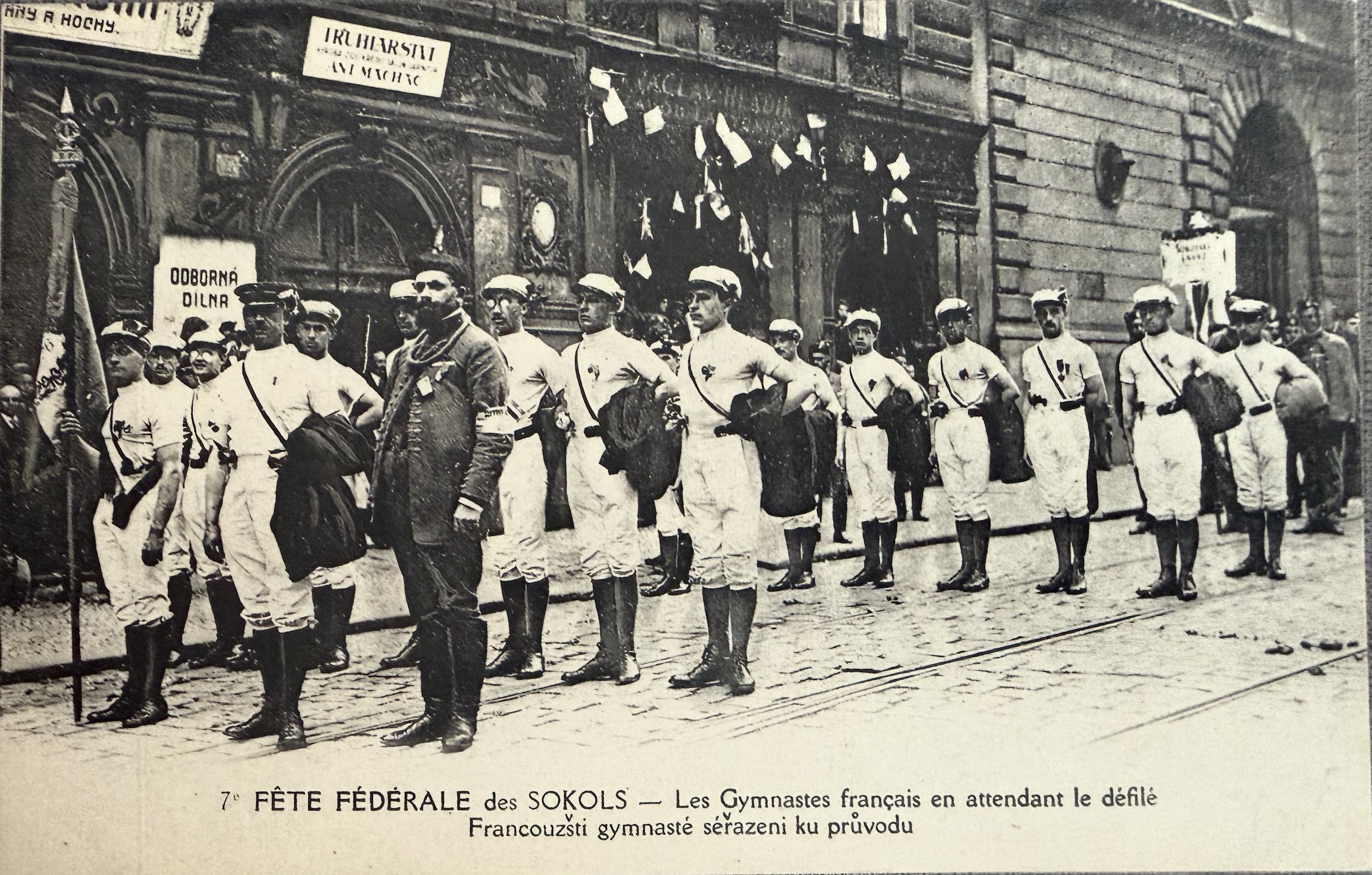
This series gathers the Sokol material in the collection around its central date. The sixth All-Sokol Slet of 28 June to 1 July 1912 was the largest gathering the movement had yet held and fell in its fiftieth year — the reverse of the commemorative postcard, shown below, carries the dates 1862–1912 along with the publisher Minerva of Prague and the price of 12 haléřů — and it is the same year Svojsík constituted Junák. Two further picture postcards show the French gymnastic delegation on Wenceslas Square, marching behind their president M. Racine and then drawn up waiting for the procession; the slets drew teams from the whole Slavic world and from allied movements in France, which is how a Prague rally came to be captioned in French.
A note on one uncertainty. The two French-captioned postcards read «7e Fête Fédérale des Sokols», which does not match the Czech numbering — the Prague slets run I 1882, II 1891, III 1895, IV 1901, V 1907, VI 1912, VII 1920 — so either the French federation counted differently or the cards belong to a later rally than the rest of the group. They are catalogued here with the 1912 material on the strength of the subject, not of a settled date.