
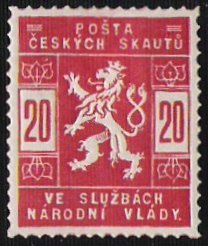
Czech lion — 20 h red
Piece details
Identity
- Piece codeStamp code YYYY.ENT.SS-PP — series code plus stamp order (e.g. 1900.CGH.01-02).
1918.CSK.01-02- SeriesThe set this stamp belongs to.
- Czech Scout Post — National Liberation
1918.CSK.01· piece 2 of 2 - EntityPostal authority that issued the stamps (country, territory, or historical entity).
 Czechoslovakia (CSK)
- Year / date
- 1918-11-07
- Face valueDenomination on the stamp; +n is a charity surcharge when present.
- 20 h
- Format
- Stamp
- TypeIssue kind. Charity issue = postage + voluntary surcharge (e.g. 6+4), not an overprint.
- Definitive
- Colors
- Red
- CollectionIn collection if you have it; Purchased if it is bought but not yet received (do not buy again); Wanted otherwise.
- ✓ In collection
Production
- Designer
- J. Panenka
- Printer
- Kolmana Printing Office
- Process
- Typography; plate with perforations and embossing, all made in one impression
- PerforationsHole gauge between stamps (e.g. 12, 13½). Higher ≈ finer.
- Roleta
- Size
- 24 x 28 mm
Catalog numbers
- DomfilDomfil thematic catalog number (scouting).
- 918.2
- MichelMichel catalog number (Europe / DE).
- CS HII
- Stanley GibbonsStanley Gibbons catalog number (UK / Commonwealth).
- CS 2
Notes
So-called Boy Scout Edition. Boy Scouts temporarily provided the local postal service in 1918.
Series history
After the collapse of Austria-Hungary in late 1918, a provisional National Council government took power in Prague while the new Czechoslovak state was still being organised. From 7 to 25 November 1918 the regular postal administration could not yet guarantee official mail for the Council. Prague Sea Scouts were therefore entrusted with a short-lived Official Mail Delivery Service — the Czech Scout Post (Pošta skautů).
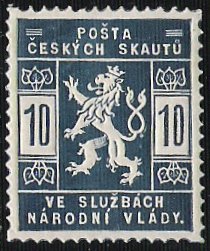
Sea Scouts carried government and related correspondence across the city. Each delivery was typically signed or marked by the messenger scout. Two adhesives prepaid the service: a 10 h blue and a 20 h red, both showing the rampant Bohemian lion (symbol of Bohemia and of national sovereignty). They are listed among the classics of Scouts on Stamps (after the 1900 Mafeking siege issues) and as local Official stamps of Czechoslovakia (Scott OL1–OL2).
The Scout Post ended on 25 November 1918, when ordinary postal authorities resumed responsibility for the mail. Later, for the arrival of President Tomáš Garrigue Masaryk in Prague (December 1918), remaining stocks of the two stamps were overprinted “Příjezd presidenta Masaryka” (Arrival of President Masaryk) — red overprint on the blue 10 h, black on the red 20 h — for a very short commemorative use (often described as essentially a one-day issue). Overprint varieties and inverted overprints exist; forgeries of stamps, overprints and covers are well known.
Original handstamps of the service (for example the circular POŠTA SKAUTŮ cancel and delivery inscriptions) later circulated privately and were abused to manufacture enhanced or fake covers. Expertisation, including Pittermann’s classification of Scout Post entires, is therefore important for postal history material. Surviving archive material of the provisional government, including Scout Post records, was largely lost when Prague City Hall burned in May 1945.
ATA 1964 adds production and postal-history colour: under Chief Scout Roessler Orovsky the Sea Scouts moved official mail between city hall, police, parliament and the railway station. Each adhesive was printed from a single typographed die so that design, perforation outline and embossing were struck in one impression (hence colour on the ‘perforations’). Inscriptions read Czech Scout Post / In the Service of the National Government; cancels include N.V. (National Committee) and Pošta Skautů in black, violet or red. The 10 h prepaid postcards and the 20 h letters, with the Scout collecting the fee on delivery and the receiver signing a receipt space — effectively registered local mail. About ninety-six Sea Scouts had their signatures on approved lists for identity checks. The December 1918 «Příjezd presidenta Masaryka» overprints (about 600 of each, unofficial) and the base stamps are heavily forged; crude fakes of stamps and covers are common.