
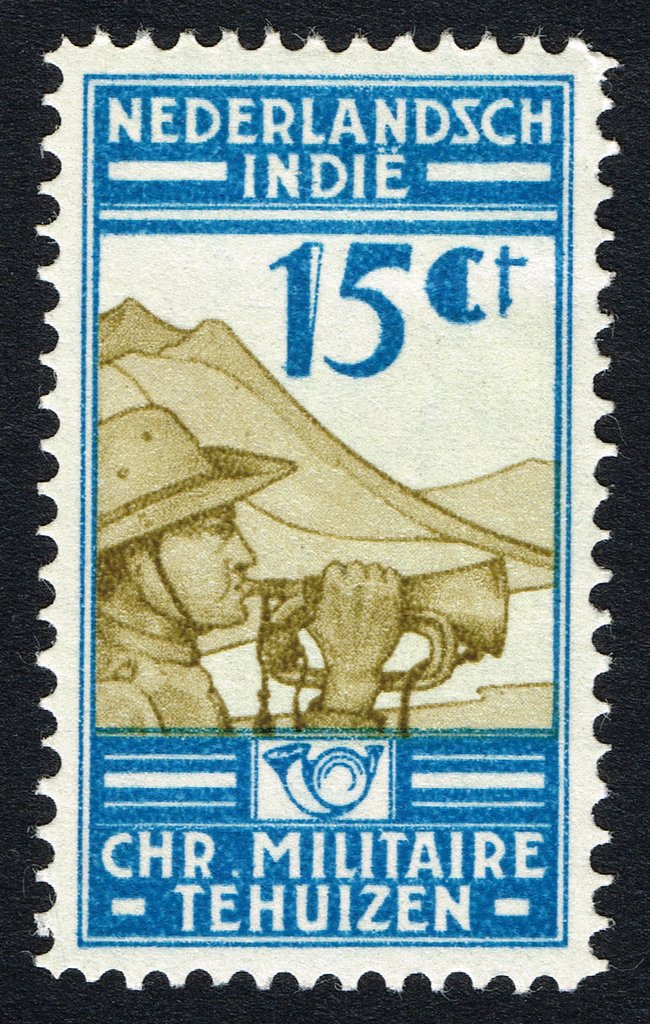
Bugler — 15 + 5 c
Piece details
Identity
- Piece codeStamp code YYYY.ENT.SS-PP — series code plus stamp order (e.g. 1900.CGH.01-02).
1935.NLI.01-04- SeriesThe set this stamp belongs to.
- Surtax for the Christian Military Association (Chr. Militaire Tehuizen)
1935.NLI.01· piece 4 of 4 - EntityPostal authority that issued the stamps (country, territory, or historical entity).
 Netherlands Indies (NLI)
- Year / date
- 1935-04-01
- Face valueDenomination on the stamp; +n is a charity surcharge when present.
- 15 + 5 c
- Format
- Stamp
- TypeIssue kind. Charity issue = postage + voluntary surcharge (e.g. 6+4), not an overprint.
- Charity issue
- Colors
- Blue / sepia
- CollectionIn collection if you have it; Purchased if it is bought but not yet received (do not buy again); Wanted otherwise.
- ✓ In collection
Production
- PerforationsHole gauge between stamps (e.g. 12, 13½). Higher ≈ finer.
- 12½
- Printing
- Photogravure
- Size
- 22 × 36 mm
Catalog numbers
- ScottScott catalog number (Americas).
- NL-IN B24
- MichelMichel catalog number (Europe / DE).
- NL-IN 233
- YvertYvert & Tellier catalog number (FR).
- NL-IN 206
- Stanley GibbonsStanley Gibbons catalog number (UK / Commonwealth).
- NL-IN 374
Notes
Army bugler (thematic Scout-collection link via reveille motif). Surtax for Christian Military Homes.
Series history
On 1 April 1935 the postal administration of the Netherlands Indies issued a set of four bi-coloured semi-postal stamps whose surtax went to the Indies Committee of the Christian Military Association for the East and West Indies (Christelijke Militaire Tehuizen — Christian Military Homes). The stamps were valid for postage until 31 January 1936. Designs by F. A. Wagner were printed in photogravure by Joh. Enschedé (Haarlem), line perforation 12½, size about 22 × 36 mm, without watermark.
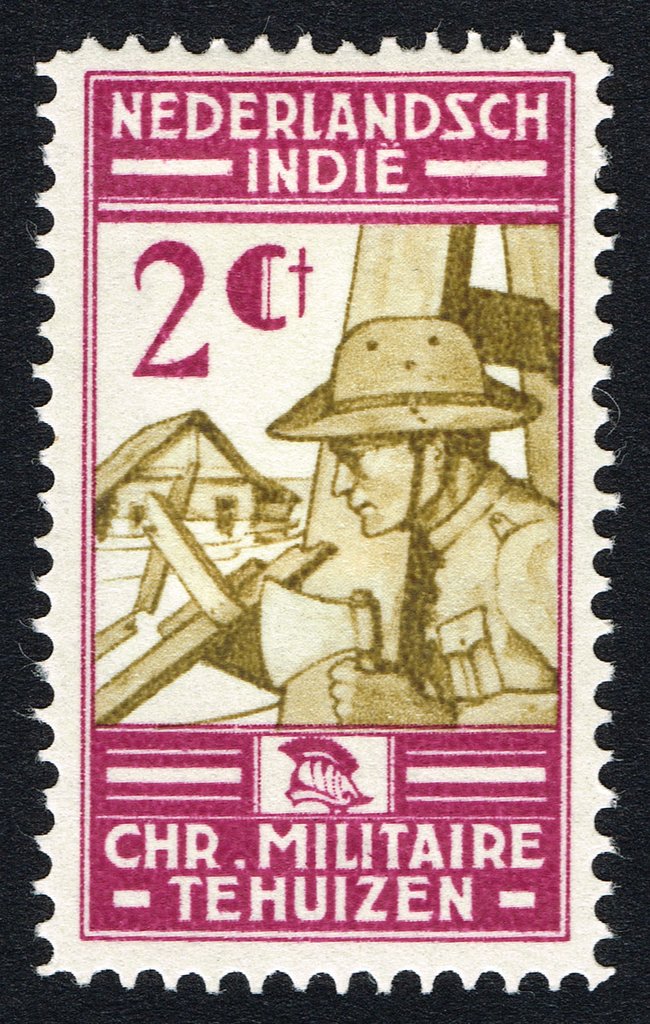
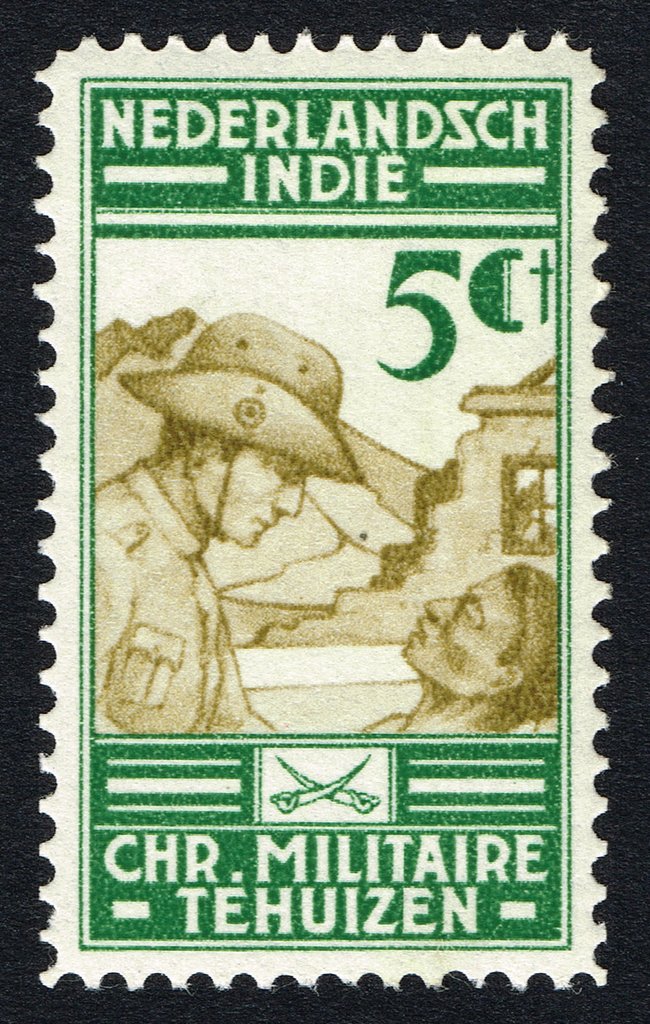
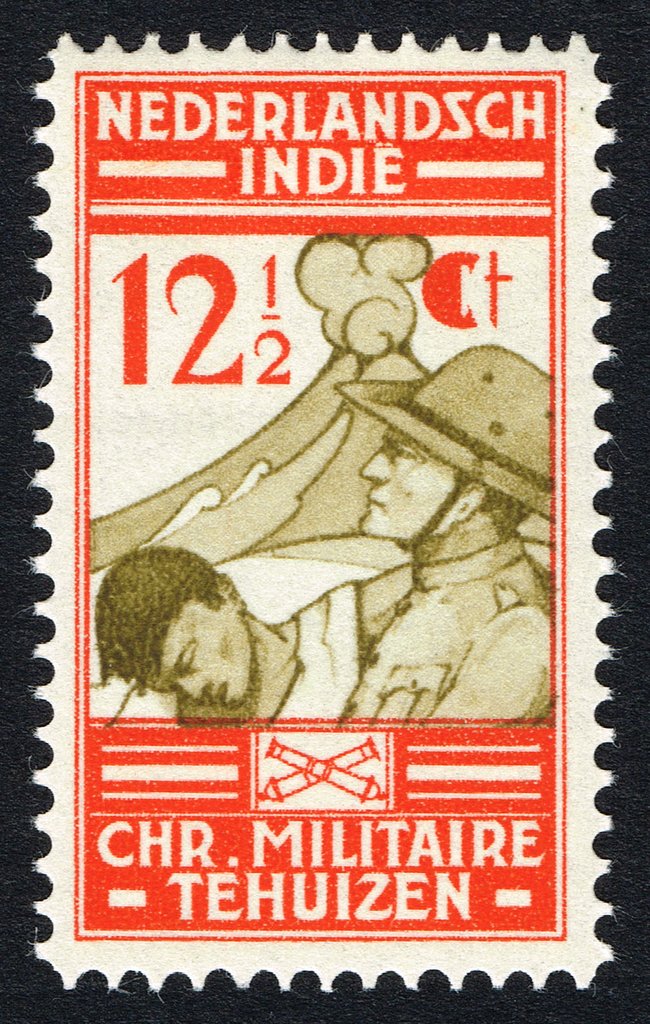
The four military scenes climb in face value: a pioneer (military engineer) at work (2 + 1 c, violet and sepia); a cavalryman rescuing a wounded native (5 + 2½ c, green and sepia); an artilleryman under fire (12½ + 2½ c, orange and sepia); and a bugler sounding the call (15 + 5 c, blue and sepia). Each stamp carries the colonial heading «Nederlandsch-Indië» and the charity legend for the Christian Military Homes. Scott catalogues the set as B21–B24; Michel as 230–233.
Relationship to Scouting. This is not an official Scout postal issue. The beneficiary was a Christian military welfare organisation that ran homes (tehuizen) for soldiers of the Royal Netherlands Indies Army (KNIL), not the colonial Scout association (Nederlandsch-Indische Padvindersbond / related bodies). Domfil does not list the set under Scout numbers. It enters Scout thematic collections for a classic reason of design: the high value shows an army bugler — the same reveille motif that Scout catalogues index on many military and youth stamps (compare Romania 1935, Domfil 935.6). The low value’s «pioneer» is a military pioneer, not a Scout rank, but the word has long invited album cross-references. True Scout postage from the Indies followed two years later: the May 1937 semi-postals for the V World Scout Jamboree in the Netherlands (Scott B30–B31), with surtax for the local Scout association.
In short, 1935 B21–B24 is a military-charity semi-postal of the colonial Indies; its place in a Scouts-on-Stamps album is thematic (bugler / youth-military imagery and sheet tradition), not organisational.